Sunday, March 9, 2014

Lizzie!

Lizzie!
by Maxine Kumin
Language: English
New York : Seven Stories Press, [2014]
ISBN: 9781609805180; 1609805186
Summary: A bright, curious girl in a wheelchair who enjoys visiting a petting zoo in her Florida town uncovers a mystery surrounding a shack full of screeching monkeys.
Available: http://www.amazon.com/Lizzie-Maxine-Kumin/dp/1609805186/ref=lh_ni_t?ie=UTF8&psc=1&smid=ATVPDKIKX0DER

Thursday, January 16, 2014

Ici Julie Joyal : une sorte de petit roman en quarante et un tableaux

Ici Julie Joyal : une sorte de petit roman en quarante et un tableaux
by Jean-Pierre April
Language: French
Montréal : XYZ éditeur, 2009.
162 p. ; 21 cm. 
ISBN: 9782892615463; 2892615461
Summary: Julie Joyal, née par insémination artificielle, est à la recherche de son père biologique.

Thursday, March 28, 2013

Missing me

Missing me
by Sophie McKenzie
Language: English
London : Simon and Schuster, 2012.
290 p. ; 22 cm.
ISBN: 9780857077271; 0857077279
Summary: Six years have passed since the end of 'Sister, Missing'. Madison is now a teenager and learns that their biological father was an anonymous sperm donor and sets out to track him down. Her search bears fruit sooner than she expects, but is the father she discovers all he seems? As Madison gets drawn into a mysterious investigation involving missing girls and secret hideaways, she finds herself in more and more danger.
http://www.sophiemckenziebooks.com/

Wednesday, January 16, 2013

Kid kind

Kid kind
by Caja Cazemier
Language: Dutch
Houten : Van Holkema & Warendorf, 2001.
144 p. ; 22 cm.
ISBN: 9026993986; 9789026993985
Summary: Als ze bijna 16 is, komt Emma erachter dat haar vader niet haar biologische vader is; ze gaat op zoek naar haar identiteit. Vanaf ca. 12 jaar.
Google translation: When she was almost 16, is Emma finds out that her father is not her biological father, she goes in search of her identity. From about 12 years.
http://www.cajacazemier.nl/

Friday, June 29, 2012

Dads, geeks and blue haired freaks

Dads, geeks and blue haired freaks
by Ellie Phillips
Language: English 
London : Electric Monkey, 2012.
295 p. ; 20 cm.
ISBN: 9781405258197; 1405258195  
Summary: Sadie Nathanson spends her life trying to survive the excruciating embarrassment of simply existing. It's hard enough being a bit of a shrinking violet within a loud and outspoken extended family, but the unexpected card from 'Dad' on her 15th birthday is the last straw. As 'Dad' was an Internet sperm-donor, it doesn't take a genius to work out that this is a bad joke, probably set up by her ex-best-friend Shonna. But it starts Sadie wondering - just who was her father? Is he the cause of her worry crinkle and wonky bum? What would happen if she tracked him down? So she decides to do just that. With help from her nerd cousin Billy, his friend Nodding Tony and a regular dose of 'Haironomics' (Sadie's own hairstyle-related philosophy system), they uncover a lot more than they bargain for.
http://www.elliephillips.co.uk/

Wednesday, June 13, 2012

The Library of Congress Finally Acknowledges Donor Offspring: (But this is only a beginning)

In 2009, I published an article for the American Fertility Association entitled, "Librarians at a Loss to Help Donor Offspring," which I just last month reworked for the AASL blog. In it, I talked about the difficulty identifying books for parents and donor offspring children due to a lack of recognition by the Library of Congress in the form of an official subject heading. In 2010, Patricia Mendell and I published an article in Children & Libraries about self-published children's picture books about assisted reproductive technology. It included an extensive annotated bibliography of about 38 titles which was the entire number of books that we were able to identify at that time. (The number of children's books on that topic has since doubled).

The list was significant because, other than the list first published by the American Society for Reproductive Medicine (ASRM) and compiled by Elaine Gordon, PhD and Ellen Speyer, MFT and the ASRM Education Committee, there was no other comprehensive list of children's books on this subject. As a librarian, such a list should have been a breeze to compile. I figured I would start with ASRM's list and then search for those books in the Library of Congress, see what subject headings were assigned to catalog them, and then create a new list. Well, it turned out, that would be impossible as the Library of Congress had no subject headings for "Donor offspring," "Children of gamete donors, or "Children of surrogate mothers," let alone subject headings for children of egg donors, sperm donors, or embryo adoption. Having already identified a few titles about these subjects that were included in the Library of Congress, but not cataloged as such, I wrote to them and suggested they create a new subject heading, "Donor-conceived," defined as individuals who have been created via sperm, eggs, or embryos donated by another person (a gamete donor). I also figured that since I myself was a librarian, my suggestion would have some influence. This is what I wrote:
There are many subject headings for "Children of --", i.e. Children of celebrities, Children of rabbis, Children of single parents, etc., but there are no subject headings for "Children of sperm donors" or "Children of surrogate mothers" or any of the assisted reproductive technologies. As a librarian, I have identified over 40 children's and YA books that have major characters who are the children of sperm donors, egg donors, etc., which is crucial to the plot and purpose of the book. Yet there is no subject heading under which to search for these books. My lists are here: http://booksfordonoroffspring.blogspot.com and here: http://yabooksfordonoroffspring.blogspot.com if you would like to see the books I've identified. There are more than enough to constitute the creation of a new LC subject heading. I would love to hear back from you on this as well. I'm a huge fan of the LC and I am at your site every day for my work.
However, this is the response I received:
We have not had the need to establish a heading for the children of sperm donors, as we have not cataloged any items that specifically focus of that topic. The existing headings have been adequate for the items that we've cataloged. We establish new headings only as they are needed for cataloging new works being added to our collection.
Not deterred, I wrote back to them:
How about "Artificial insemination, Human -- Offspring" or "Surrogate mothers -- Offspring?" These subject headings focus on the parents who produce these children, but there are no subjects yet for the donor-conceived. For example, the book: Sperm Donor Offspring: Identity and Other Experiences by Lynne W. Spencer, has as its subject headings: "Sperm banks -- United States" and "Artificial insemination, Human" but other than the title, the average patron might not know that this is a book about donor offspring if they were searching for a book that addressed the specific concerns of donor offspring.
And this is what they wrote back:
Our practice has been to use headings such as "Artificial insemination, Human" and "Surrogate motherhood" to catalog works on this topic.
That was in April 2009. Fast forward to June 2012 when I received a letter from noted radical librarian Sanford Berman, who is to the Library of Congress what Socrates was to ancient Athens and who is the subject of his own biography, Everything You Always Wanted to Know About Sandy Berman But Were Afraid to Ask. He read our article in Children & Libraries in August 2010 and himself wrote to the Library of Congress on our behalf suggesting they add the subject heading "Donor offspring" based on the extensive list of children's books put forth in our article. His letter informed me that the Library of Congress had finally decided to create a new subject heading for "Children of sperm donors." I jumped out of my chair when I read this! While some would like to believe that this announcement by the Library of Congress marks the beginning of an official public acknowledgement recognizing the existence of families created with the help of donors, the reality is that once again the rights of the donor-conceived are still being only partially represented and totally misunderstood. It is clear that the Library of Congress, in creating this new subject heading for "Children of sperm donors," has shown that they lack a genuine understanding of the donor offspring created with gamete donation, but also the implications both medically and psychologically surrounding the use of assisted reproductive technology (ART), as they also use the subject heading "Test tube babies" for children conceived via in vitro fertilization (IVF) even though they are created in petri dishes and not test tubes.

While their new subject heading follows their own convention for "Children of --," as in "Children of gay parents," and "Children of single parents," (two official LC subject headings), it is less than adequate and quite limiting for librarians trying to help these families find resources, as only one group of donor offspring is represented - children of sperm donors. If the subject heading must be listed under children, then it should be entitled "Children of gamete donors." Other variants then could be "Donor-conceived" or "Donor offspring."

While some will feel positively now that the Library of Congress has at last begun to acknowledge children created through donation with the assistance of another person, my colleague and co-author Patricia Mendell is less optimistic. "As a mental health practitioner who has been working in the field of reproductive medicine for over 25 years, the decision by the Library of Congress to create a subject heading for only one group of donor offspring is not only disappointing and frustrating, but hurtful and offensive to the thousands of donor-conceived individuals and their families who have been created with the help of assisted reproductive technologies."

When I decided to write to the Library of Congress in 2009, it was clear that they needed to create an all encompassing subject heading for the donor-conceived. Also, using the subject heading "Donor-conceived" would be the best and most accurate subject heading since it would recognize all individuals created with the help of a donor. The subject heading "Children of sperm donors" used for "Sperm donors' children," seems to imply an ownership or affiliation that may or may not feel accurate to the donor-conceived.


While the next step might be to get the Library of Congress to create subject headings for "Children of egg donors," "Children of surrogate mothers," and "Children of embryo donation," we would suggest instead that they look at the subject heading "Donor-conceived." Although it was possible to find some of this material using the existing Library of Congress subject headings like "Infertility," and "Artificial insemination -- Human," there was nothing that identified the experience of being a donor offspring. Books such as Janice Grimes' book series, Before you were born: our wish for a baby were cataloged as "Artificial insemination -- Human." And the Iréné Celcer series, Hope and Will have a baby was cataloged with "Infertility," and "Test tube babies" as subject headings. These subject headings were wholly inaccurate and inadequate. So how to find these books will remain a big challenge if one is looking for books about those conceived via surrogate mother, egg, and embryo donation.

I plan to continue to write to the Library of Congress and share with them the books that I have discovered without the help of a Library of Congress subject heading, urging them to create further change in how they catalog their books for this population of children. We know that of the many children's books on this subject, over 95 percent have been self-published, but many have not been sent to the copyright office of the Library of Congress. We would ask that these authors register their books and in so doing put pressure on the Library of Congress that they must, and need to, have a subject heading for "Donor-conceived."

 This post was co-authored with Patricia Mendell

Tuesday, May 29, 2012

Catch & Release

Catch & release
by Blythe Woolston
Language: English
Minneapolis : Carolrhoda Lab, ©2012.
210 p. ; 20 cm.
ISBN: 9780761377559; 0761377557
Summary: Eighteen-year-old Polly and impulsive, seventeen-year-old Odd survive an deadly outbreak of flesh-eating bacteria, but resulting wounds have destroyed their plans for the future and with little but their unlikely friendship and a shared affection for trout fishing, they set out on a road trip through the West. 
http://www.blythewoolston.net/

My Mixed-Up Berry Blue Summer

My mixed-up berry blue summer
by Jennifer Gennari
Language: English 
Boston : Houghton Mifflin Books for Children, 2012.
119 p. : ill., map ; 20 cm.
ISBN: 9780547577395; 0547577397
Summary: Twelve-year-old June Farrell spends the summer at her Vermont home getting used to the woman her mother is planning to marry and practicing her pie-baking skills, as she hopes to win the blue ribbon at the fair.
http://www.jengennari.com/

Burnout

Burnout
by Adrienne Maria Vrettos
Language: English 
New York : Margaret K. McElderry Books, ©2011.
193 p. ; 22 cm.
ISBN: 9781416994695; 1416994696
Summary: Months after coming out of alcohol and drug rehab, high school student Nan wakes up on the subway the day after Halloween wearing a torn Halloween costume, her long hair cut, and "HELP ME" scrawled across her chest, feeling sick and having no idea how she got there.
http://adriennemariavrettos.com/

Sunday, May 6, 2012

Librarians at a Loss to Help Donor Offspring

I do research. It might be why I became a librarian. I love to look things up, and then I enjoy the thrill of finding what I am looking for. I also enjoy looking things up for other people. But one of my favorite things to do is to look up subjects that are hard to find. But first you have to find subjects that are hard to find, and then try to find them. Well, I stumbled upon one. It’s books for and about donor offspring. What are donor offspring? They are children conceived via sperm or egg donation.

In 2003, I read a book review in Booklist of the book, Donuthead, by Sue Stauffacher. In the review, it was mentioned that the main character’s mother had had her son via artificial insemination. Serendipitously, I mentioned this to a friend who had an interest in this topic and she said, can you find me other books like that? Excited to perform a search, I said, “sure.” (I actually consider searching a hobby). So of course the first thing I did was go to the Library of Congress. I was going to take a look at their subject headings and just follow them and it would lead me to similar books. Well not so fast. It didn’t happen that way at all. The subjects listed for Donuthead were:

Friendship
Courage
Fear
Self-actualization (Psychology)
Single-parent families
Mothers and sons 

Where were the subject headings telling me that the main character was donor-conceived? There were none. Okay. Dead end. I wasn’t expecting that. Where do I go next? I decided to broaden my search by doing a keyword search. Of course this was an option from the beginning, I just wasn’t happy about it. I thought this would be easy. I searched the term “donor offspring” as that is what adults conceived via gamete donor call themselves. A search for this term turned up one book, Experiences of donor conception : parents, offspring, and donors through the years by Caroline Lorbach. I looked at the subject headings and decided to use those to again narrow my search. I found as subject headings:

Human reproductive technology
Infertility – Treatment
Reproductive health

This was not helpful. I was looking for juvenile fiction similar to Donuthead in which the main character was a “donor offspring.” I wanted to impress my friend with my searching skills. Maybe there were no other books? Could be. Long story short, there were other books. The trick was to use so many different keywords to actually find them, but I did find some. But why no uniform subject headings for books that were essentially all about the same subject? I wrote to the Library of Congress about this myself. I gave them the list of all the books I had found that were written for children, and that were in their catalog, who were donor offspring and this is the response I got:
We have not had the need to establish a heading for the children of sperm donors, as we have not cataloged any items that specifically focus on that topic. The existing headings have been adequate for the items that we’ve cataloged. We establish new headings only as they are needed for cataloging new works being added to our collection.
Why were they not responsive? And from a librarian no less? A little reading on the Library of Congress turns out that they have a history of not being responsive to adding or changing their subject headings. Have you heard of Sanford Berman, Library of Congress gadfly? Turns out he’s been battling the Library of Congress to change its subject headings for years so that real people, not just librarians, can find what they are looking for. He actually cited me in an article I wrote so I decided to write to him, and I was happy to hear that he not only read my article in Children & Libraries, but employed his gadfly expertise to lobby them to add a new subject heading. I suggested “Children of sperm donors,” or “Children of egg donors,” or “Children of gamete donors.” Surely these children need representation in the Library of Congress as the Library of Congress subjects headings are the “de facto standard for libraries,” as Hope A. Olson states in her book, The Power to Name. Isn’t it in naming something that we acknowledge that something, someone exists? The existence of these children were not acknowledged by the Library of Congress. At the time I wrote to them, I had discovered thirteen children’s books that were written either for donor offspring children, or about donor offspring children. Thirteen! (And I have since found so many more). And maybe thirteen doesn’t sound like a lot, but did you know that the Library of Congress has just one book on the children of epileptics, yet this category of people gets its own subject heading? Same for the children of clergy in England, the children of coal miners in France, and the children of mentally ill mothers, to name a few. Just one book each! Yet I had identified so many more for the subject I was proposing be added, but the Library of Congress does not budge on these matters apparently. So where does this leave us? It leaves us with people like me who love to look for the hard-to-look-for. I have ended up having to use up to thirty different keywords to find books that could be found with just one subject heading: “donor offspring,” or, to follow Library of Congress conventions, “Children of gamete donors.” But I have managed. To date I have found about seventy-six books written for donor offspring children, and I have found about fifteen books written for young adults, and boy has it been fun searching for the unsearchable. I will continue to publish about this as nobody else is, and maybe the Library of Congress will eventually listen.

Monday, April 30, 2012

Spenderkind (Donor Child)

Spenderkind
by Katrin Stehle
Language: German
Stuttgart : Gabriel Verlag/Thienemann, 2012.
237 pp.
ISBN: 9783522302845; 3522302842
Summary from Google Translate: Lina has great parents and her friend Julian. She is envied by many. But a day can change EVERYTHING. The day when Lina learns that her father is not her biological father. Is he really still your father? And as if that were not confusing enough, Lina feels suddenly attracted to Nick as well as to Julian. What matters more - the old or the new, the genes or the emotions? Lina has to find out necessarily where it belongs. A book about love, family ties and the search for identity.
Interview with the author: http://cms.thienemann.de/index.php?option=com_thienemann§ion=2&av=3&Itemid=11&view=interview&interid=74 http://www.katrinstehle.de/

Friday, July 15, 2011

On the Other Hand

On the other hand
by Jean Gill
Language: English
Talybont, Ceredigion : Y Lolfa, 2005.
136 p. ; 19 cm.
ISBN: 9780862437718; 0862437717
Summary: A mix of gripping story with fascinating facts on left-handedness. Everyone should think left-handed - or so 14 year old Jamie thought when she tied her hand behind her back for a day-long protest in school, against persecution of left-handers over the centuries. Her best friend Ryan publicised their cause with a new series of articles in the school magazine but just when their campaign is going well, Ryan's Mum drags him off from Wales to live in America. There he faces bullying at its most deadly and Jamie has to live from one email to the next to know whether her friend is coping.
http://www.jeangill.com/

Tuesday, July 12, 2011

Who Am I? : experiences of donor conception

Who Am I? : experiences of donor conception
with foreword and afterword by Alexina McWhinnie.
Leamington Spa, Warwickshire : Idreos Education Trust, 2006
vi, 66 p. ; 21 cm.
ISBN: 9780955403101; 0955403103

Behind closed doors : moving beyond secrecy and shame

Behind closed doors : moving beyond secrecy and shame
edited by Mikki Morrissette ; in affiliation with the Donor Sibling Registry.
[S.l.] : Be-Mondo Publishing, 2006.
94 p. ; 23 cm.
ISBN: 0977204219; 9780977204212

Sperm donor offspring : identity and other experiences

Sperm donor offspring : identity and other experiences
Lynn W Spencer.
[Charleston, SC] : Booksurge, ©2007.
150 p. ; 23 cm.
ISBN: 1419672614; 9781419672613

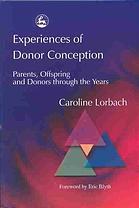
Experiences of donor conception : parents, offspring, and donors throughout the years

Experiences of donor conception : parents, offspring, and donors throughout the years
Caroline Lorbach.
Philadelphia, PA : Jessica Kingsley Publishers, 2003.
ISBN: 184310122X; 9781843101222
Summary: "Drawing on the experiences of parents, offspring and donors and including her own and her family's story, this thought-provoking and informative book explores the process of donor conception. From finding out about an infertility problem, to considering whether - and how - to tell the children about their conception, and how those children feel as the adult offspring of a donor, she provides practical suggestions as well as in-depth consideration of the emotional and ethical issues involved."

"Lorbach takes the reader step-by-step through the process of deciding to use donor conception, choosing a donor, and discussing the decision with others and considers the perspective of the donor alongside those of parents and offspring. Tackling difficult subjects such as disclosure and offspring's access to information about the donor, this important book is a much-needed resource for health, counseling and social work professionals as well as for the couples and families themselves."--BOOK JACKET.

Friday, July 1, 2011

Nobel genes

Nobel genes
Rune Michaels
Language: English
New York : Atheneum Books for Young Readers, ©2010.
181 p. ; 22 cm.
ISBN: 9781416912590; 1416912592
Protagonist: boy, approximately 12
Summary: A boy whose manic-depressive mother has always told him that his father won a Nobel Prize, spends his time taking care of her and searching for clues to the identity of the Nobel Prize-winning sperm donor, eventually finding a truth he must learn to accept.
http://www.runemichaels.com/
Book Reviews: School Library Journal, Publishers Weekly, Booklist, Bulletin of the Center for Children's Books, Library Media Connection, Kirkus Review

Qui est ma mère?

Qui est ma mère?
Charlotte Kerner ; traduction de l'allemand par Geneviève Granier ; illustrations, Bruno Mallart.
Language: French
Paris : Hachette Jeunesse, ©1993.
315 p. : ill. ; 17 cm.
ISBN: 2010190041; 9782010190049
Summary: French translation of "Geboren 1999". An adopted boy searches for his birth parents only to find he is the product of artificial insemination. For junior high and high school students.
http://charlottekerner.de/

Saturday, May 2, 2009

Finding Cassidy

Finding Cassidy
by Laura Langston
Language: English
Toronto : HarperTrophyCanada, ©2006.
237 p. ; 22 cm. 
ISBN: 0002553163; 9780002553162
Summary: Sixteen-year-old Cassidy's world is turned upside-down when she learns that her father has been diagnosed with a fatal disease. She is further devastated to learn that he isn't her biological father.
Reviews: Canadian Children's Book Review
http://lauralangston.com/

Monday, April 27, 2009

Call me Mimi: The World's Ugliest Beauty Queen

Call Me Mimi: The World's Ugliest Beauty Queen
by Francis Chalifour
Language: English
Toronto : Tundra Books, ©2008.
178 p. ; 20 cm.
ISBN: 0887768237; 9780887768231
Reading level: Young Adult
Protagonist: girl, 17
LOC Summary: Seventeen-year-old Mimi, overweight, heads to Toronto to find her sperm donor father after things go awry at her prom. 
My review: Overweight, seventeen-year-old Mimi has always known that her mother conceived her via anonymous sperm donation and Mimi has spent her entire life looking for this phantom father who she has never met in this young adult novel from Canada.  Her favorite pastimes are Céline Dion, history, and a game she often plays with herself when she is walking down the street: looking at men and wondering: "Is that man with the briefcase my father? What about the one with the folded La Presse? Or the one looking at his reflection and picking his teeth, God forbid?" Mimi likes to stare at every man she passes, "men in jogging shorts, men in ragged jeans, men in chinos ... Could any of them be my father? ... When I'm on the subway, or when I walk down the street, and I see a man, there's always this thought that maybe it's him." 


Finally, after years of the anguish of not knowing who she really is, she decides to take a trip to Toronto after high school graduation, to the sperm bank her mother used in order to have her. The problem is, her mother refuses to let her go on her own, even though she is about to start college in the fall. "I don't understand. Why is finding him so important to you?" her mother asks. But Mimi does not have an immediate answer, only that she believes it will help her to find herself in her "quest for the truth" and to "put myself in order."  But Mimi does make it to Toronto and Mimi does know what she is looking for, as she confides in a friend she later meets there, "I need to know where I come from. It would be nice to know about his genetic background, like if he has cancer, or heart disease, or Alzheimer's in his family. It's always useful to know." But, she confesses to herself, "that's not what I was looking for. I wanted to find my roots. If I knew him, perhaps I would know myself better. I also wanted the love of a father." And, "to let him know that I exist." As her quest continues, Mimi becomes even more clear to herself what she is looking for when she finally makes her way to the sperm bank and is asked why she came. "My primary goal is to learn more about his family history, looks, talents, and interests. I would also like to have some sort of medical history and an idea of how many pregnancies were conceived from this donor." And also if she has any brothers and sisters. Mimi is however crushed to learn what many sperm donor children often learn, that the information on her donor dad is kept "strictly confidential." "The sperm donors are guaranteed that their names will not be released." The sperm bank does however release some public bits of information about him, that he is: "Caucasian. Red hair. Blue eyes. 5 foot 9. 140 lbs. Blood group, O positive," and that his interests include history. Mimi is ecstatic with this information.
Reviews: School Library Journal

Sunday, April 19, 2009

Between Mom and Jo

Between Mom and Jo
by Julie Anne Peters
Language: English 
New York : Little, Brown, 2006.
232 p. ; 22 cm.
ISBN: 0316067105; 9780316067102
Reading level: Young Adult
Protagonist: 14
Summary: Fourteen-year-old Nick has a three-legged dog named Lucky 2, some pet fish, and two mothers, whose relationship complicates his entire life as they face prejudice, work problems, alcoholism, cancer, and finally separation.
Reviews: Publishers Weekly, Booklist, School Library Journal, Voice of Youth Advocates, Bulletin of the Center for Children's Books, Horn Book

Awards: Lambda Literary Award 2007

http://www.julieannepeters.com/

In Your Room

In Your Room
by Jordanna Fraiberg
Language: English 
New York : Razorbill, 2008.
202 p. ; 21 cm.
ISBN: 1595141936; 9781595141934
Readling level: Young Adult
Summary: Teens Molly and Charlie connect through email when their complicated families exchange houses for the summer, but a misunderstanding threatens the emerging relationship just when the two are about to secretly meet.
Reviews: Booklist, Kliatt

http://jordannafraiberg.com/

Headlock by Joyce Sweeney

Headlock
by Joyce Sweeney
Language: English 
New York : Henry Holt, 2006.
214 p. ; 21 cm.
ISBN: 080508018X; 9780805080186
Reading level: Young Adult
Protagonist: 18
Summary: High school senior Kyle is determined to become a professional wrestler but his dream is threatened by a loved one’s illness and the dramatic reappearance of a long-absent relative.
Reviews: Voice of Youth Advocates, Publishers Weekly, School Library Journal, Booklist, Bulletin of the Center for Children's Books

http://joycesweeney.net/index.htm

Demons at My Doorstep: The Search for My Donor Father by Greg Wiatt and Katherine Marsh

Demons at My Doorstep: The Search for My Donor Father...
By Katherine Marsh, Greg Wiatt
Contributor Greg Wiatt
Published by iUniverse, 2004
ISBN 0595320007, 9780595320004
260 pages

Saturday, April 18, 2009

Brave new Wanda : a novel

Brave new Wanda : a novel 
by Lynda Rutledge 
Language: English 
La Porte, Ind. : WordFarm, ©2004. 
189 p. ; 21 cm.
ISBN: 0974342750; 9780974342757
Reading level: Adult/Young Adult
Protagonist: 13

Friday, April 10, 2009

The sperm donor's daughter & other tales of modern family

The sperm donor's daughter & other tales of modern family 
by Kathryn Trueblood 
Language: English 
Sag Harbor, NY : Permanent Press, ©1998. 
166 p. ; 23 cm.
ISBN: 157962006X; 9781579620066
Reading level: Young Adult/Adult
Protagonist: 20
Reviews: Publishers Weekly, Kirkus Reviews

Tuesday, April 7, 2009

Feathered

Feathered
by Laura Kasischke
Language: English 
New York : HarperTeen, ©2008.
261 p. ; 19 cm.
ISBN: 0060813180; 9780060813185
Reading level: 18+
Protagonist: girl, 18
LOC Summary: While on Spring Break in Cancun, Mexico, high-school seniors and best friends Anne and Michelle accept the wrong ride and Michelle is lost--seemingly forever.
My review: Narrated by her friend, Anne, this is the story of 18-year-old Michelle, and of the trouble she gets into on vacation in Mexico with her two best friends. Michelle is the product of sperm donation and this has caused Michelle a life-long ache for a father. As Anne writes, "Once, I asked her if she was sad about not having a father, or not knowing who her father was. She just said, 'I'm always looking,' and I knew she meant that the looking was the bad part. Not the not having, but the blank space always waiting to be filled." Michelle has always known about her origins as her mother, as described by Anne, has "a policy about being open about everything," leaving "nothing left to the imagination at all," and this of course includes having been honest with Michelle from the beginning. Michelle, however, wishes her mother could have been just a little more sensitive on the subject of fathers. One day, after Doughnuts for Dads day at school, Michelle comes home and tells her mother, "I want a daddy." "You'll never have one," is her mother's blunt reply. But no matter how insensitive her mom is on the subject of fathers, Michelle's longing and curiosity can not be steeped.  "You can never shake it," she tells Anne. "Every man you see, you think, maybe that's my sperm. I mean, father. It's like the whole world's full of sperms, walking around, crossing the street, buying burgers at McDonald's." Michelle's mom is not at all attuned to Michelle's feelings on the subject, and Michelle thinks her mom might just as well not have been so honest with her. "She should have told me that she'd had a one-night stand, and he was dead," as it is this very knowledge of her sperm donor origins that leads Michelle into trouble.

Michelle is particularly attuned to men with blue-green eyes who play the cello and have curly dark hair as those were the attributes of the sperm, her mom had told her, that she had selected. While in Mexico, Anne and Michelle meet a man with these very attributes and accept his offer of a ride to the Mayan ruins several hours away from their hotel. Michelle is convinced that the ride is safe because she thinks the man could be her father, and in fact, is her father. What happens to Michelle after that trip to the Mayan ruins is the plot of the novel and it is intimated by the author that because of Michelle's yearning to connect with her biological father, she has poor judgment in a situation that leaves her in an intensely exposed and vulnerable situation. This book is recommended for mature teens only.
Reviews: Voice of Youth Advocates, Booklist, School Library Journal, Horn Book, Kirkus Review, Kliatt

My so-called family

My so-called family 
by Courtney Sheinmel 
Language: English 
New York : Simon & Schuster Books for Young Readers, 2008. 
194 p. ; 22 cm.
ISBN: 1416957855; 9781416957850
Recommended for ages: 9-12
Protagonist: 13
Summary: Leah, who was conceived through a donor bank, decides that even though she loves her mother, stepfather, and stepbrother, she wants to find out if she has any other siblings, and sets out to investigate without telling anyone what she is doing.
Reviews: School Library Journal, Publishers Weekly, Horn Book, Bulletin of the Center for Children's Books, Kirkus Review

http://www.courtneysheinmel.com/

Go Figure By Jo Edwards

Go Figure
by Jo Edwards
Language: English
New York : Simon Pulse ©2007.
x, 271 p. ; 21 cm.
ISBN: 1416924922; 9781416924920
Reading level: Young Adult
Protagonist: 17
Summary: Ever since she was identified as a "fat girl" at cheerleading camp in fifth grade, Ryan's been on a mission to shed more than a few pounds. Lately she's also on the hunt for a new relationship. Now that her ex-boyfriend is a rock star - currently posing on the cover of Rolling Stone - Ryan seriously needs to move on.
Reviews: Publishers Weekly, Voice of Youth Advocates

http://www.joedwardsbooks.com/

Perfect girl

Perfect girl
by Mary Hogan
Language: English
New York : HarperTempest, ©2007.
196 p. ; 22 cm.
ISBN: 0060841087; 9780060841089
Reading level: Young Adult
Protagonist: 14
Summary: Ninth-grader Ruthie Bayer realizes that she is in love with her best friend Perry, the boy next door, but when competition appears, Ruthie calls on her glamorous aunt for advice.
Reviews: School Library Journal, Horn Book, Kliatt, Kirkus Review

http://www.maryhogan.com/

The other half of me

The other half of me 
by Emily Franklin 
Language: English 
New York : Delacorte Press, ©2007. 
247 p. ; 22 cm. 
ISBN: 038573445X; 9780385734455
Reading level: Young Adult
Protagonist: 17
Summary: Feeling out of place in her athletic family, artistic sixteen-year-old Jenny Fitzgerald, whose biological father was a sperm donor, finds her half sister through the Sibling Donor Registry and contacts her, hoping that this will finally make her feel complete.
Reviews: Voice of Youth Advocates, School Library Journal, Booklist, Bulletin of the Center for Children's Books, Horn Book, Kliatt

http://www.emilyfranklin.com/

Goddess games

Goddess games 
by Niki Burnham 
Language: English 
New York : Simon & Schuster Books for Young Readers, 2007. 
282 p. ; 19 cm.
ISBN: 141692700X; 9781416927006
Reading level: Young Adult
Summary: Three high school girls from very different social backgrounds deal with their problems and learn how to get along together while working at a mountain resort for the summer.
Reviews: School Library Journal, Horn Book

http://www.nikiburnham.com/

Donorboy : a novel

Donorboy : a novel 
by Brendan Halpin 
Language: English 
New York : Villard, ©2004. 
209 p. ; 21 cm.
ISBN: 1400062772; 9781400062775
Reading level: Adult/Young Adult
Protagonist: girl, 14
Summary: Rosalind had two mommies. Now, thanks to a tragic accident involving foodstuffs, she has none. And Sean, the sperm donor responsible for half her DNA (and nothing else), is taking custody. Rosalind finds herself adjusting to a new life that seems both hateful and surreal-she's an orphan with a new father, surrounded by friends she is beginning to despise and well-meaning adults who succeed only in annoying her. Sean made a donation fifteen years ago, and his life since has not gone according to plan. Thirty-five, single, and still grieving the loss of his own mother twenty-seven years ago, he decides to take on the overwhelming task of caring for an unhappy teenager he doesn't know. Told entirely through e-mail, instant messaging, journal entries, and other random communications, Donorboy is the comic, compellingly readable novel of how these two people learn to converse, cook, write heavy-metal songs, and nail windows shut on their way to becoming a family. Brendan Halpin has written a universal story of how we laugh, cry, and occasionally punch our way to a new life in the face of tragedy.
Reviews: School Library Journal, Publishers Weekly, Booklist, Kirkus Review
Awards: Alex Award 2005

http://www.brendanhalpin.com/

Singing the Dogstar blues

Singing the Dogstar blues 
by Alison Goodman 
Language: English 
New York : Viking, 2002. 
261 p. ; 22 cm.
ISBN: 0670036102; 9780670036103
Reading level: Young Adult
Protagonist: girl, 18
Summary: In a future Australia, the saucy eighteen-year-old daughter of a famous newscaster and a sperm donor teams up with a hermaphrodite from the planet Choria in a time travel adventure that may significantly change both of their lives.
Reviews: Publishers Weekly, School Library Journal, Booklist, Voice of Youth Advocates, Bulletin of the Center for Children's Books, Kirkus Review

http://www.alisongoodman.com.au/stdb.html

Donutheart

Donutheart
by Sue Stauffacher
Language: English 
New York: Random House Children's Books, 2006
199 p. ; 22 cm.
ISBN: 0375832750; 9780375832758
Protagonist: boy, 12
Recommended for ages: 9-12
LOC Summary: Usually preoccupied with his own concerns about hygiene and safety and with his crush on Glynnis, sixth-grader Franklin Delano Donuthead finds that he is unaccountably worried about his mother’s feelings and his friend Sarah’s difficult home life.
My review: Sequel to Donuthead. "Sometimes I try to imagine what my own father looks like. We have never met him. He just...well...provided the ingredients. I don't know how to talk about this to people who don't already know. Some people think a child who is the product of a mom and a sperm donor is just plain weird. If only they knew - there are millions of us in schools across America!" So asserts Franklin Delano Donuthead who often wonders about his father, and who feels different from most people, not always because he is the product of sperm donation, but because of his obsession with hygiene, and his one leg which he perceives to be shorter than the other.

Other than Franklin always knowing that he was the product of sperm donation, his mother doesn't tell him much about his origins, only that she "wanted a healthy guy," and a "normal-dog-loving-athletic sports fan" which Franklin most definitely is not. Franklin understands his origins though by creating the metaphor of his mother having wanted to bake a cake, but not having all the ingredients. But "my mother wanted a baby, not a cake (and) this required sperm, not flour. And since I bear little resemblance to my mother in either looks or personality, she may have grabbed the container that advertised: 'sensitive-intelligent-asymmetrical-immaculate male' in her rush to get the whole business over with." This is what Mom got instead, as Franklin defends when he says, "I can hardly be held responsible for my own genes, now can I?"

Franklin is a well-developed and hysterically funny character who has a friend at the CDC who he checks in with regularly because he is so tormented by germs, so much so that he has to sing the entire "Happy Birthday" song all the way through while washing his hands or he feels his hands have not spent a sufficient amount of time in contact with soap and water. Franklin's being the product of sperm donation is not the main plot of the book. His friendship with the disshelved new girl in his class is. But the author has done a good job creating a credible back story for Franklin and of bringing up some of the legitimate concerns that may have a bearing on some sperm donor children. At one point, wondering whether a certain male teacher could be his father because he too has one leg shorter than the other, has the same build, hair and eye color, as well as an obsession with cleanliness, leads Franklin to wonder whether discovering who his "real, true, flesh-and-blood father" is would be a disappointment, and "would, in fact, be worse than not knowing." This is however a funny book and not a heavy one, and children of sperm donors may enjoy meeting a funny character who shares the same origins. This book was published in 2003 and happens to be the very first young adult book with a donor offspring character.
Reviews: School Library Journal, Voice of Youth Advocates, Booklist, Publishers Weekly, Bulletin of the Center for Children's Books, Horn Book

Donuthead

Donuthead
by Sue Stauffacher
Language: English 
New York: Random House, 2003
144 p. ; 22 cm.
ISBN: 0375824685; 9780375824685
Recommended for ages: 9-12
Protagonist: boy, 11
LOC Summary: Franklin Delano Donuthead, a fifth-grader obsessed with hygiene and safety, finds an unlikely friend and protector in Sarah Kervick, the tough new student who lives in a dirty trailer, bonds with his mother, and is as "irregular" as he is.
My review: "Sometimes I try to imagine what my own father looks like. We have never met him. He just...well...provided the ingredients. I don't know how to talk about this to people who don't already know. Some people think a child who is the product of a mom and a sperm donor is just plain weird. If only they knew - there are millions of us in schools across America!" So asserts Franklin Delano Donuthead who often wonders about his father, and who feels different from most people, not always because he is the product of sperm donation, but because of his obsession with hygiene, and his one leg which he perceives to be shorter than the other.

Other than Franklin always knowing that he was the product of sperm donation, his mother doesn't tell him much about his origins, only that she "wanted a healthy guy," and a "normal-dog-loving-athletic sports fan" which Franklin most definitely is not. Franklin understands his origins though by creating the metaphor of his mother having wanted to bake a cake, but not having all the ingredients. But "my mother wanted a baby, not a cake (and) this required sperm, not flour. And since I bear little resemblance to my mother in either looks or personality, she may have grabbed the container that advertised: 'sensitive-intelligent-asymmetrical-immaculate male' in her rush to get the whole business over with." This is what Mom got instead, as Franklin defends when he says, "I can hardly be held responsible for my own genes, now can I?"

Franklin is a well-developed and hysterically funny character who has a friend at the CDC who he checks in with regularly because he is so tormented by germs, so much so that he has to sing the entire "Happy Birthday" song all the way through while washing his hands or he feels his hands have not spent a sufficient amount of time in contact with soap and water. Franklin's being the product of sperm donation is not the main plot of the book. His friendship with the disshelved new girl in his class is. But the author has done a good job creating a credible back story for Franklin and of bringing up some of the legitimate concerns that may have a bearing on some sperm donor children.  At one point, wondering whether a certain male teacher could be his father because he too has one leg shorter than the other, has the same build, hair and eye color, as well as an obsession with cleanliness, leads Franklin to wonder whether discovering who his "real, true, flesh-and-blood father" is would be a disappointment, and "would, in fact, be worse than not knowing." This is however a funny book and not a heavy one, and children of sperm donors may enjoy meeting a funny character who shares the same origins. This book was published in 2003 and happens to be the very first young adult book with a donor offspring character.
Book Reviews: Publishers Weekly, School Library Journal, Booklist, Bulletin of the Center for Children's Books, Horn Book
Awards: Nene Award, (nominated) Prairie Pasque Award 2006, (nominated), Rhode Island Children's Book Award 2005, (nominated) William Allen White Children's Book Award 2006, (won) Bluegrass Award 2006, (nomiated), Sequoyah Book Award 2006, (nominated), Maud Hart Lovelace Award (nominated)

http://www.suestauffacher.com/